
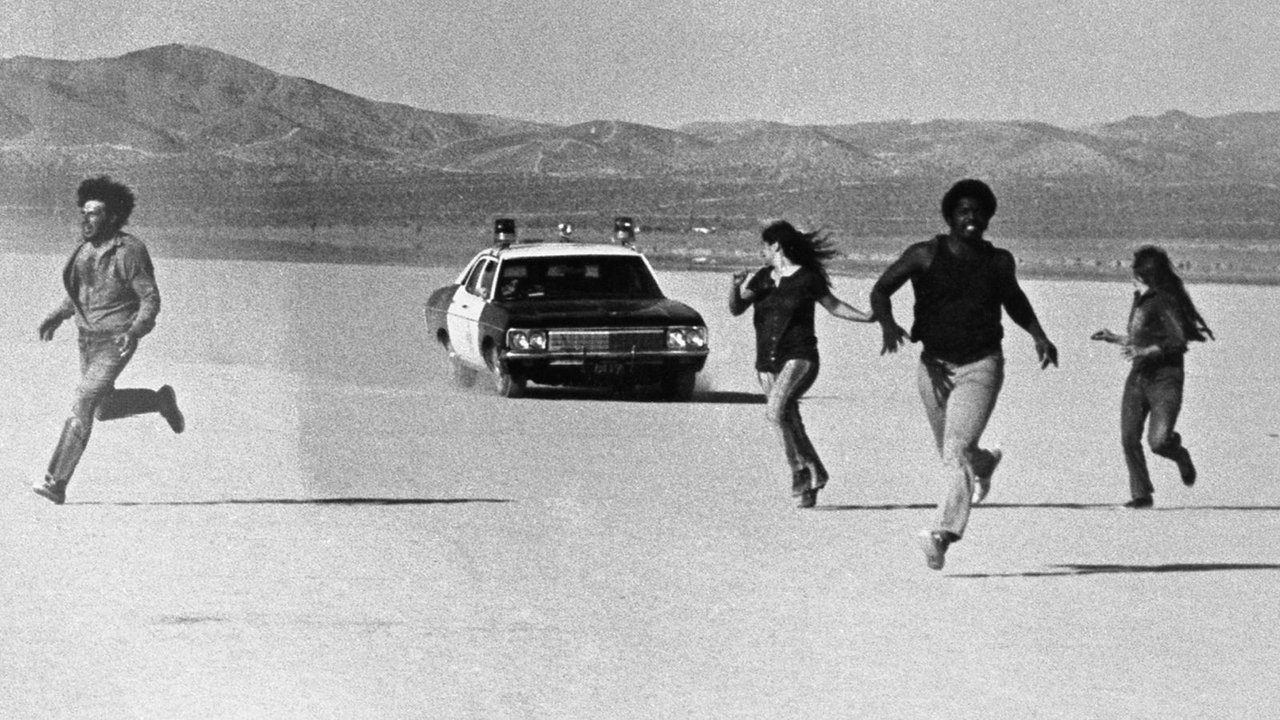
Punishment Park (1971)
In this fictional documentary, U.S. prisons are at capacity, and President Nixon declares a state of emergency. All new prisoners, most of whom are connected to the antiwar movement, are now given the choice of jail time or spending three days in Punishment Park, where they will be hunted for sport by federal authorities. The prisoners invariably choose the latter option, but learn that, between the desert heat and the brutal police officers, their chances of survival are slim.
What people think about Punishment Park
Punishment Park is special because it feels less like a movie and more like a piece of forbidden footage you’re not supposed to be watching, a pseudo-documentary so convincing it makes your skin prickle with recognition. Peter Watkins stages its tribunal debates and desert “game” with a raw, urgent realism that turns political rhetoric into lived panic, and the thriller mechanics into something bracingly moral—every shouted argument and exhausted stumble lands with purpose. The tone is abrasive, angry, and relentlessly tense, building a heat-haze dread that doesn’t let up, and that’s exactly why it lingers long after the credits. It’s not for viewers looking for comfort or escapism—its violence and cruelty are severe—but if you want cinema that challenges, provokes, and still feels eerily contemporary, this is a brilliant, unsettling essential.
Punishment Park is trying to hit you like a siren: a faux-documentary warning about state power, political repression, and how quickly “law and order” turns into legalized cruelty. It’s raw, confrontational, and intentionally repetitive in its arguments, which means if you don’t share its outrage going in, it can feel shrill, hectoring, and more like an endurance test than a thriller. The violence and verbal abuse are punishing rather than entertaining, and the handheld, semi-improvised style can read as gritty realism or just chaotic and exploitative, depending on your tolerance. If you want nuance, character depth, or a sense of catharsis, this likely isn’t for you—but if you can handle an abrasive, bleak political provocation, it’s unsettling in a way that still lands.
Cast
- PPatrick BolandTribunal Defendant
 Carmen ArgenzianoJay Kaufman (Tribunal Defendant)
 Kent ForemanLee Robert Brown (Tribunal Defendant)
- LLuke JohnsonWilliam Luke Valerio (Tribunal Defendant)
- KKatherine QuittnerNancy Jane Smith (Tribunal Defendant)
- SScott TurnerJames Arthur Kohler (Tribunal Defendant)
- SStan ArmstedCharles Robbins (Tribunal Defendant)
- MMary Ellen KleinhallAllison Mitchner (Tribunal Defendant)
- MMark KeatsWilliam C. Hoeger (Tribunal Chairman)
- GGladys GoldenMary Jurgens (Tribunal Member)
- SSanford GoldenSenator Harris (Tribunal Member)
- GGeorge GregoryMr. Keagan (Tribunal Member)
- NNorman SinclairTribunal Member
- SSigmund RichProf. Hazlett
- PPaul RosensteinTribunal Member
- LLee MarksFederal Agent
- SSandy CoxStenographer
- FFrederic FranklynDefense Attorney
Crew
- Director
- Peter Watkins
- Writers
- Peter Watkins
- Producers
- Susan Martin
- Cinematography
- Joan Churchill
- Editing
- Terry HodelPeter Watkins
Details
- Released
- October 1, 1971
- Language
- English
- Studio
- Churchill Films, Françoise Films, Chartwell
- IMDb
- tt0067633