
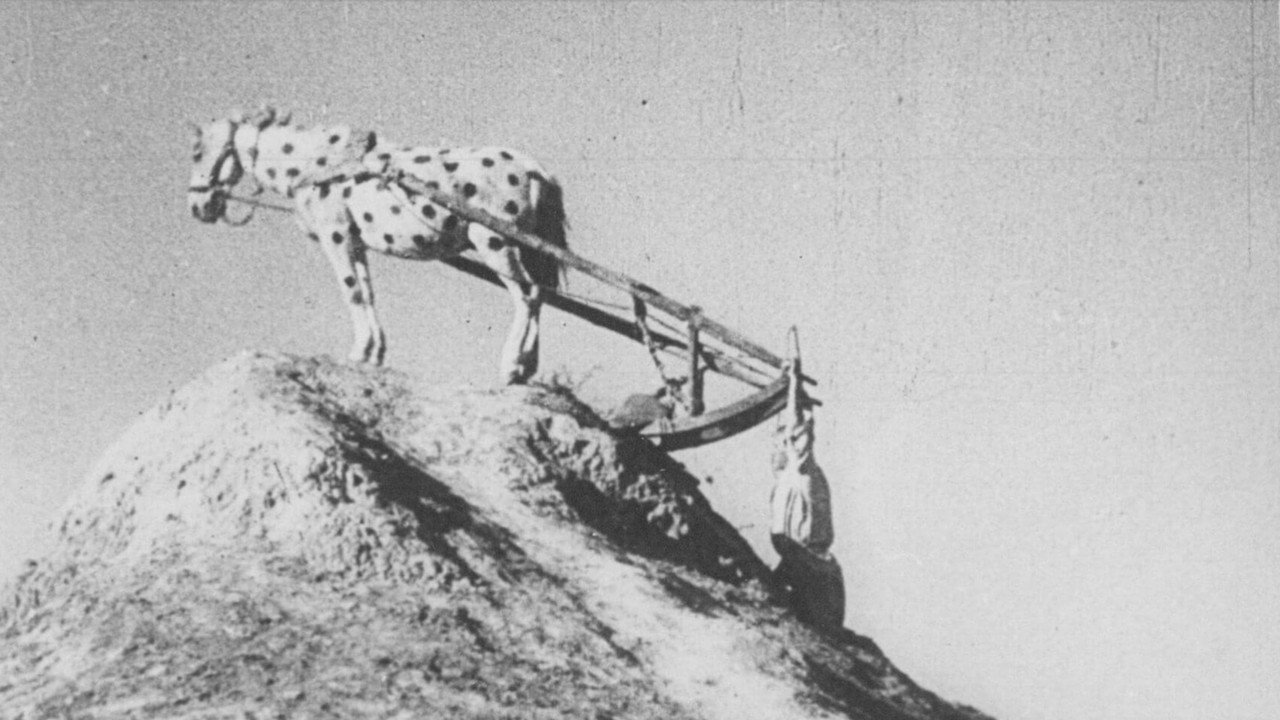
Happiness (1935)
A hapless loser (with the surname of Loser) undergoes misadventures with avaracious clergy, a tired horse, and a walking granary (among other things) on his road to collectivized happiness.
What people think about Happiness
Happiness is special because it feels like a silent-era clown stumble into a razor-sharp social satire: Aleksandr Medvedkin stages poverty, bureaucracy, and “good intentions” as a carnival of absurdity that’s funny until you realize how close to the bone it cuts. The film’s misadventures—priests squabbling, officials taking their “share,” a horse that simply refuses to be heroic—play with the buoyant rhythm of physical comedy, yet there’s a bruised human tenderness underneath, especially in the push-and-pull between a feckless dreamer and the wife who’s tired of waiting for luck to arrive. It’s brisk, inventive, and packed with visual gags that land even today, while quietly charting a shift from private desperation to collective life. Fair warning: it’s also unmistakably a product of its political moment, so if you’re allergic to ideological framing you may bristle—but if you can meet it on its own terms, it’s a strange, vivid little marvel that earns its laughter.
Happiness is trying to be a sly, slapstick-tinged fable about a downtrodden peasant stumbling from old-world exploitation into the supposed promise of collectivized life, with a lot of visual gags and bitter irony along the way. The catch is that it plays like an odd hybrid of silent-era comedy rhythms and pointed political parable, so if you want a tight plot, naturalistic acting, or modern pacing, it can feel repetitive, schematic, and more interested in making its argument than building emotional momentum. The humor is often broad and deliberately cruel-to-the-hero, which can be funny in an absurdist way but also exhausting if you don’t enjoy watching a man get kicked around for an hour. Still, if you’re up for an eccentric, historically loaded curiosity with inventive images and a surprisingly sharp eye for hypocrisy, it’s worth a look—just don’t go in expecting “feel-good” happiness.
Cast

Crew
- Director
- Aleksandr Medvedkin
- Writers
- Aleksandr Medvedkin
- Cinematography
- Gleb Troyanski
Details
- Released
- March 15, 1935
- Language
- Russian
- Studio
- Mosfilm, Vostokkino
- IMDb
- tt0017961